

South Korea Opens New Opportunities for Nepali Workers with E-7 Visa
South Korea has emerged as one of the best destinations for Nepali people seeking employment opportunities abroad. With its strong economy, high wages, and safe working environment, South Korea continues to attract thousands of foreign workers every year.
In a significant development, the governments of Nepal and South Korea have recently reached an agreement to allow Nepali citizens to apply for the E-7 visa. This visa category is specifically designed for skilled and semi-skilled workers in industries such as manufacturing, construction, agriculture, caregiving, hospitality, and technology.
Until now, many Nepalis were working in Korea under the EPS (Employment Permit System) with the E-9 visa, which mostly covered unskilled labor jobs. The introduction of the E-7 visa for Nepali workers is being seen as a major step forward because it offers better career prospects, longer stay periods, and the possibility of bringing family members in the future.
According to labor experts, the E-7 visa will open doors for Nepali youths with technical knowledge, vocational training, or professional skills who are looking for dignified jobs abroad. Not only does it promise higher income compared to many other labor destinations, but it also ensures improved labor rights and social security benefits.
This new initiative reflects the growing partnership between Nepal and South Korea. It is expected that thousands of Nepalis will benefit from this opportunity in the coming years, helping reduce unemployment at home while also contributing to Nepal’s remittance-driven economy.
For young Nepali workers dreaming of building a secure future, South Korea’s E-7 visa could be a golden gateway.
How to apply?
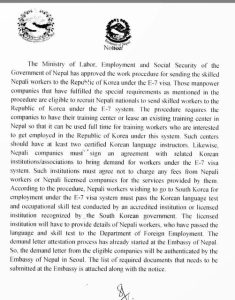
Here’s how Nepali workers can apply for the South Korea E-7 visa—the specialized employment permit recently opened via recruiting agencies in Nepal. This step-by-step breakdown is based on official guidelines and local developments:
Nepal’s Ministry of Labor, Employment and Social Security has introduced a new system that allows licensed manpower agencies to send skilled Nepali workers to South Korea under the E-7 visa. Alongside this, G2G EPS (E-9) system continues to operate separately for unskilled workers.
The E-7 visa targets specialized, skilled professionals across over 85 occupations (such as management, technical fields, IT, caregiving, etc.) and is managed through private-sector recruitment, not the G2G EPS

Eligibility Requirements
Academic or Experience Criteria
Candidates must satisfy one of the following:
-
Master’s degree or higher in a relevant field.
-
Bachelor’s degree plus at least 1 year of post-degree experience.
-
Over 5 years of relevant experience.
-
Special conditions such as employment in a top-500 global company, degree from top-ranked universities, or exceptional skills may also qualify.
The Step-by-Step Application Process
-
Use only government-licensed manpower companies that run or have tie-ups with training centers providing Korean language and skill preparation with certified instructors.
-
The agency must have agreements with registered associations in South Korea, and no fee should be charged by these associations to the Nepal side.
Tests & Screening and Demand Verification
Pass both Korean language and occupational skill tests conducted by accredited institutions recognized by the Korean government. Once a Korean employer submits a demand for workers, it must be verified by the Nepali Embassy in South Korea within approximately 15 days before proceeding further.

Employment Contract
A formal employment contract with clear terms (wages, benefits, insurance, etc.) is signed and reviewed by the Nepal Department of Foreign Employment before moving ahead.
Cost or Expense
Importantly, the Korean employer must cover costs such as airfare, insurance, health checks, welfare fund, labor permit fee, and social security contributions—similar to what applies under EPS.
The cost to the worker should not exceed the current EPS cost (approx. NPR 120,000). Officials caution that if agencies overcharge (reports up to NPR 2 million), strict oversight is needed.
Salary and other Benefits
In Korea, the starting salary is around 2 million Korean Won (approximately 2 lakh Nepali Rupees). A bonus is given once a year, and it is also customary to give bonuses during the Korean New Year (Seolnal설날), the Chuseok추석 holiday, and the summer vacation. In most cases, food and accommodation are free in Korea.