

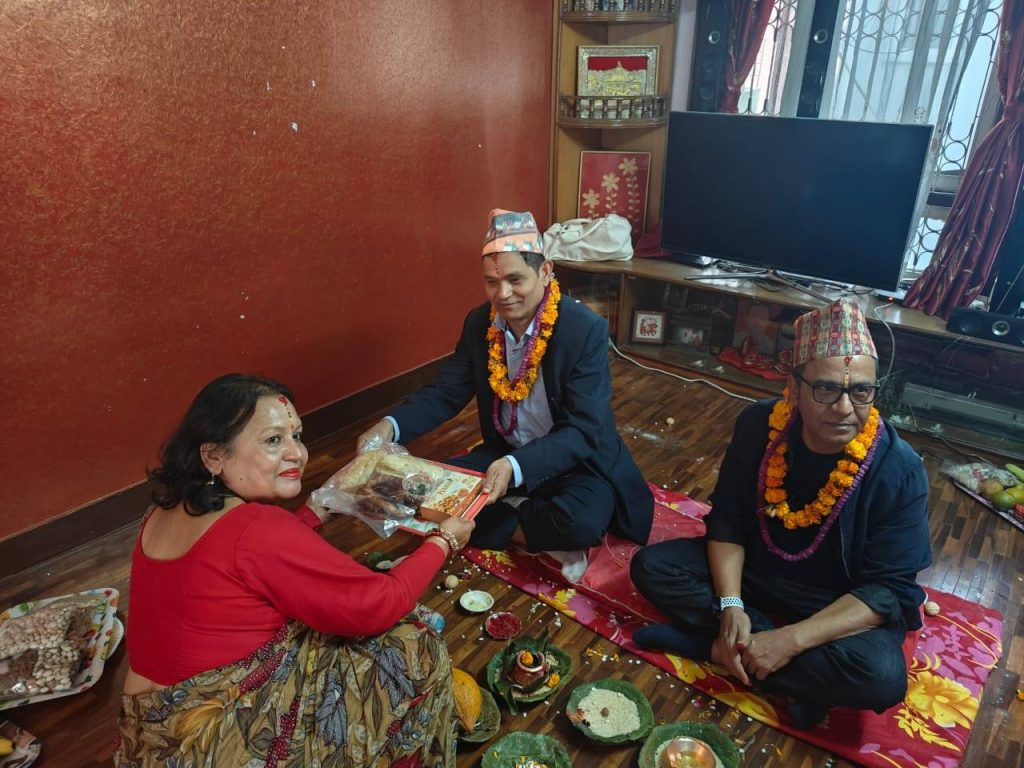
President received tika from his sisters
Today marks one of the most special and emotional days of the Tihar festival—Bhai Tika, the fifth and final day of Yam Panchak. It is a day that beautifully symbolizes the sacred bond between brothers and sisters, celebrated with deep love, rituals, and heartfelt blessings. Across Nepal, homes are filled with laughter, marigold garlands, and the sweet aroma of sel roti, fruits, and flowers. Sisters prepare special offerings and decorate the tika thali with colorful pigments—red, yellow, blue, green, and white—to place on their brothers’ foreheads, praying for their long life, prosperity, and happiness. In return, brothers offer gifts and promise to protect their sisters.
But the beauty of Bhai Tika extends far beyond the borders of Nepal. Wherever Nepalis live, Tihar travels with them—to Japan, Australia, the United States, the United Kingdom, the Middle East, and beyond. In the hearts of the Nepali diaspora, Tihar is not just a festival—it is a connection to home, a bridge between memory and reality. Even in foreign lands, far from the sound of Deusi–Bhailo and the glow of marigold lights, Nepalis gather in small communities to recreate the warmth of this festival.
Many Nepalis living abroad take leave from their busy schedules to celebrate this day. They gather in community halls or small apartments, wearing traditional dresses, preparing Nepali food, singing festive songs, and applying tika to each other as brothers and sisters. Though the setting may be different, the spirit remains the same. The feeling of family, unity, and gratitude fills the air. In countries like Japan, Korea, Australia, and the U.S., Nepali associations organize Tihar events where even children born abroad learn about the culture and traditions of their parents’ homeland.

Tourists received tika at Balgopaleshwar temple
Interestingly, Tihar is not only celebrated by Nepalis within Nepal or those living abroad, but also by Nepali-origin communities in neighboring countries. The Bhutanese Nepali community, many of whom live in resettlement countries, continue to celebrate Tihar as a reminder of their roots. Similarly, in Burmese Nepalis and Thai Nepalis, Nepali communities light lamps, decorate their homes, and perform pujas just as they would in Nepal. Despite being miles away, they find comfort and belonging in the rituals of Tihar.
This shared celebration around the globe shows how festivals like Tihar unite people across borders. It reminds everyone that tradition and culture are not limited by geography—they live in hearts and memories. Bhai Tika, especially, highlights the importance of family ties in Nepali society. It’s not just about putting tika on the forehead; it’s about expressing unconditional love, forgiveness, and appreciation for each other.
In Kathmandu, the Balgopaleshwar Temple at Ranipokhari opens its gates on this day for those who do not have brothers or sisters. People visit early in the morning to receive tika and blessings from priests, symbolizing that love and connection transcend blood relations. This inclusive spirit of Tihar—embracing everyone—is what makes the festival truly beautiful.
As the sun sets today, homes across Nepal and Nepali communities worldwide will glow with oil lamps and colorful lights. The fragrance of incense, the sound of laughter, and the warmth of togetherness will fill the night. Whether in the bustling streets of Kathmandu or the quiet suburbs of Melbourne, Tihar continues to shine as a festival of light, love, and unity.